Thursday, September 17, 2015

THE "ONE" DEMOCRAT


Antonio Borja Won Pat and Ana Salas Perez Won Pat


My family was almost exclusively Territorial and then Republican.

Only recently have some, in the younger generations, supported other parties.

Many in the family also keep very quiet about politics.

But back in the 1950s and 60s, the more vocal members of the family were publicly Territorial and then Republican. Five members of my family have been elected senators; all of them Territorial or Republican.

But the one Democrat some of my older relatives very openly supported was Antonio Borja Won Pat. This was interesting on several counts.

First, my Uncle Ben Reyes, a two-term senator (they were called Congressmen in the 50s and 60s) was not only in the party opposite Won Pat, Uncle Ben was also one of those in the 3rd Guam Legislature who booted out Won Pat as Speaker and put in his place Francisco B. Leon Guerrero.

Secondly, in those days, campaigns often involved personal attacks. Won Pat and Uncle Ben were always in rival parties and, though I never heard that they ever personally attacked each other, some of their colleagues certainly did.

Thirdly, Won Pat was said to have been a Mason or, at least, not closely allied to the Church. Uncle Ben, on the other hand, and especially his vocal wife, Auntie Ana, were "church people."

But it wasn't just Uncle Ben and Auntie Ana who supported Won Pat when Won Pat ran for the U.S. Congress election after election. My very religious grandma and grand aunts did the same, though more quietly.

I remember my Auntie Ana telling me in the 1970s, and I wasn't even a voter yet, "He's the only Democrat I vote for." Of course, only she knew what she did in the privacy of the voting booth.

The reason was personal. Won Pat's wife, Tan Ana, was a distant relative and close friend. In fact, in post-war Sinajana, the Won Pat's were neighbors until he packed up and moved to Washington, DC in the mid 60s as our Delegate and then Representative. The Won Pat house in Sinajana still stands, though now in another owner's hands.

Tan Ana'n Won Pat was a Perez on two sides; her father's non-Chamorro side and her mother's Chamorro side. The blood connection was through that maternal line.

But it was more than blood. Uncle Ben, or Auntie Ana, I forget which, was a godparent to one of the Won Pat kids. Old man Won Pat was not churchy, but his wife Tan Ana remained a practicing Catholic.


The Won Pats, parents and children


When Tan Ana passed away in the mainland and her remains were brought to Guam for final burial at the Veterans Cemetery, I was asked to officiate at the Catholic rites because of this family connection.


THE OTHER EXCEPTION


"Doc" Sanchez


Politics often brings out some funny sides to people's personalities and the election of 1976 certainly did with Auntie Ana.

Not only did she support another Democrat, she supported one who was running against Won Pat!

Pedro C. Sanchez, popularly called "Doc Sanchez," had been an academic all his life. In 1974, he was president of the University of Guam but decided to make a go of politics and run for governor. He lost the primary, coming in number two after Ricky Bordallo.

In 1976, he decided to challenge Won Pat for the Washington seat as a Democrat.

He got Auntie Ana's Republican vote.

When explaining why she supported him, she told me it was because of two things. First, she was proud of his PhD - a Chamorro who got the highest academic degree possible.

Secondly, and in her own words, she voted for him because "he brought a soul into the Catholic Church." Sanchez's wife, Flo, was born a Methodist but became a Catholic (and a very devout one) to marry Sanchez.

So, Auntie Ana said, "Even though he's a Democrat, I'm voting for him because he brought a soul into the Catholic Church."

No animosity towards Won Pat. But, this alone was enough reason for Auntie Ana to change her vote.

When Doc Sanchez lost the primary in 1976 against Won Pat, Auntie Ana went back to supporting her compadre.

Wednesday, August 12, 2015

LAY MISSIONARY


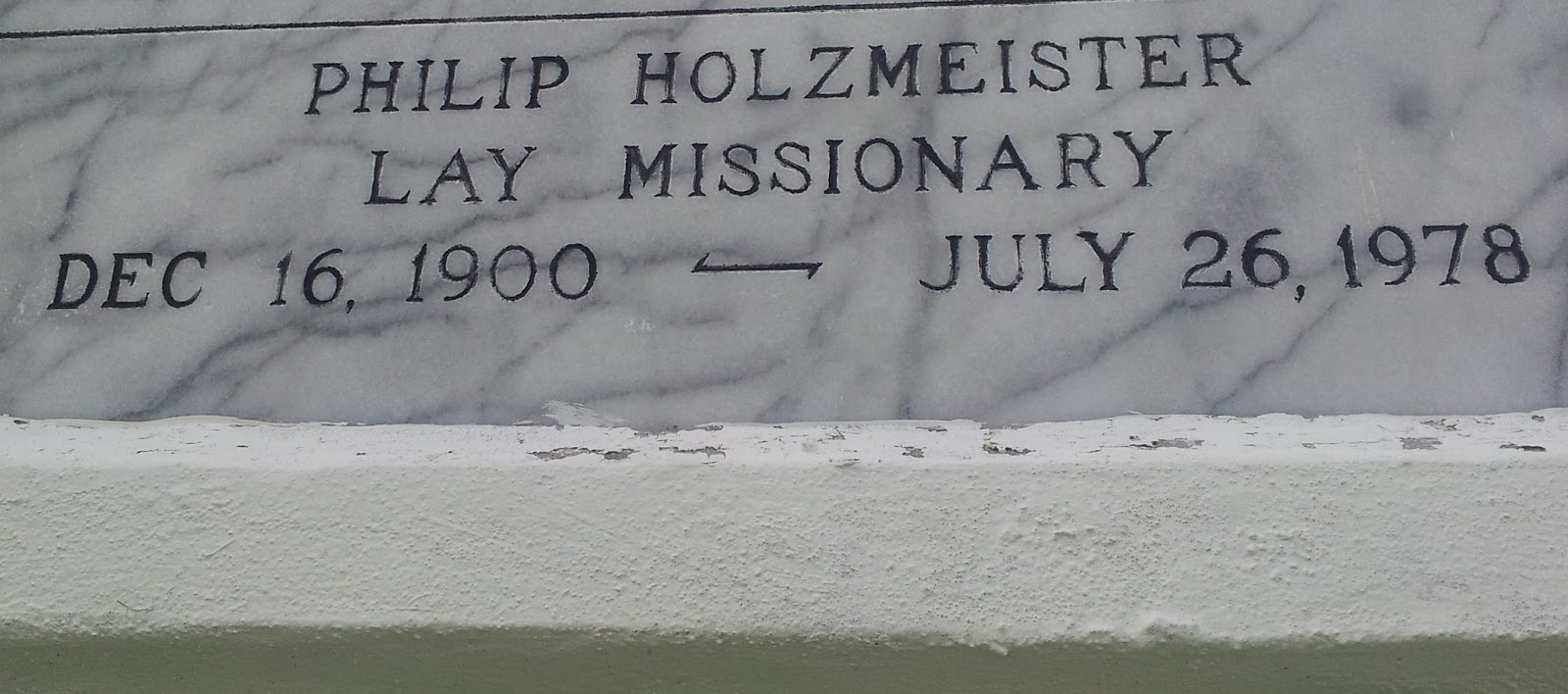
Philip Holzmeister

Lay missionaries - men and women who are neither priests, nor religious brothers nor sisters - have been a part of Church ministry since the first days of the Church in the times of the Apostles.

Many times they get little to no attention. So, it's not surprising that many people outside of the older people of Yoña would have heard of Philip Holzmeister.

He was one such lay missionary who have a large part of his life to the parish of Saint Francis in Yoña.

Having attended Saint Francis School myself for six years, I remember seeing Phil, but I had no idea who he was and why he was always seen at Saint Francis Church.

His brother, Father Adrian Holzmeister, was a Capuchin priest. Through him, Philip learned about the Guam mission and its many needs.

It was a time of tremendous building projects - churches, rectories, schools and convents - as Guam was recovering from World War II and as the island population expanded.


Saint Francis Church & School, Yoña
1950s

Phil found himself going to Yoña to help Father Alvin LaFeir, one of the primary "builder missionaries." The photo above shows the huge parish complex that Father Alvin spearheaded. Most of the labor came from the volunteer parishioners. Phil certainly had a lot of work to do every day. His work included physical and manual labor in the construction and thereafter the maintenance of the parish buildings.

Phil was a quiet man who drew no attention to himself. As a lay missionary, he was not paid a salary but the Capuchins took care of all his material needs, which were few.

When Phil died, he was buried alongside the Capuchin friars in Togcha.


REST IN PEACE, PHIL

He gave his life to the Church on Guam.
even his body lies in our soil.

Monday, July 27, 2015

A GENTLE REPROOF


I must have been 13 or 14 years old; just entering my rebellious teen years.

One particular day I was giving my Auntie Ana (above) an especially hard time just being a contrary, noisy chatterbox, bouncing off the walls, really.

Not once in my whole life did Auntie Ana ever lay a hand on me, though I did see her spank others. But, that day, her patience was wearing thin with me and, what she didn't do with her hand, she did with her icy stare and sharp scolding.

Uncle Ben (above), on the other hand, was the incarnation of gentleness.

I suppose he had had enough, too, but he had a different approach.

In a very calm tone, he said to me, "Come with me. I want to show you something."

Every boy wants to be shown something. I followed him into his little study, where he kept all his books and filing cabinets.

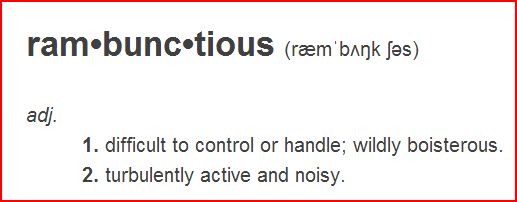
He took down his huge Webster's Dictionary and looked up a certain word. When he had found it, he pointed to it and  asked me to read out loud the term and its definition. This was it :


As soon as I read it, I felt a tinge of guilt.

Uncle Ben's method of "correction" spared me an abundance of guilt and humiliation. His method gave me just enough guilt to quiet me down. Not only did I quiet down, Auntie Ana and Uncle Ben continued with their day as if nothing had happened. I don't think I was ever rambunctious again with Auntie Ana.

Not only did he correct my behavior, he made me increase my English vocabulary!

Sometimes, this is all we need in order to correct ourselves :


Uncle Ben was a wise man.

Monday, July 20, 2015

LIBERATION : ESTORIAN AUNTIE ANA


My grandmother's sister Ana Torres Reyes
with yours truly in 1966


My grandmother's sister, Auntie Ana, lived just next door to us.

She never had children of her own to raise; a story I will relate in a few minutes. But, because of that, I was more or less adopted by her, as well as by my grandmother and two other sisters of hers. Yes, quite the spoiled child.

One of the great things about all my older relatives, or mañaina, was that they all told me stories. Here are some of the things Auntie Ana told me about the war (1941-1944).


NERVES


Japanese village names of Guam, or Omiya Jima (Great Shrine Island)


Auntie Ana's husband, Uncle Ben, was made soncho, or village chief, of Barrigada (called Haruta Mura in Japanese) during the war.

That was not a position anyone in their right mind wanted.

You were essentially the enforcer of Japanese demands on your own people if you were the soncho.

The soncho went out and told the people what the Japanese wanted. And it was the soncho who got punished if the people did not satisfy the Japanese. If the Japanese ordered ten bags of corn from the farmers, and the soncho only produced eight, it was the soncho, not the farmers, who usually got punished.

That is why, my aunt said, every morning when Uncle Ben would leave the house to begin his work day, she would begin her hours of anxiety and worry. Would Uncle Ben come home with bruises from punches or cuts from whippings? And even when Uncle Ben would come home alright, he would drink to soothe his anxieties, and Auntie Ana was always nervous about that.

So, needless to day, Auntie Ana was a ball of nerves every moment she was awake.


THE DEATH OF LITTLE VICENTE


Some wondered if her nerves and anxieties were part of the reason why she was not able to bear children (except one). She had numerous miscarriages. Of course, the Japanese Occupation lasted only two and a half years, so only a couple or several of them might be due to wartime conditions. Still, there must be some connection.

Her only child who lived for just one day was born during the war. He was sickly the moment he saw the light of day, but lived long enough to be baptized Vicente, the name of his father. There were only two priests on Guam during the Occupation, and one lived far away in Inarajan, so midwives (pattera) or others in the family usually did the baptizing especially in cases of risky births.

When little Vicente died after a day, they put his tiny body in a shoe box and buried him at the farm in Ungaguan, Barrigada where they lived, not far from the other relatives in our clan. No priest, no funeral rites. They just said their prayers. But, little Vicente died an angel, so there was no need for prayers for his soul, which instantly went to heaven. The prayers would have been for the consolation of the parents.


SEWING HIS CLOTHES


UNCLE BEN REYES AFTER THE WAR
And in better clothes than during the war


Auntie Ana was educated in a girls' finishing school in Manila in the 1920s and 30s. She was very good in English and became a school teacher on Guam. But she could also sew and cook. During the Occupation, however, fabric was scarce.

Auntie Ana took me one day to a room where she opened a kaohao, which is a wooden chest traditionally kept by Chamorro families. Important things are kept in a kaohao, like documents, bridal gowns, christening båta or gowns and the like.

Inside this kaohao were Uncle Ben's wartime clothing. Auntie Ana showed me the shirts and trousers which she repaired with her own hands, since new clothes could not be bought. It all looked so antique. I remember how there was no zipper, as they were not in vogue yet. Instead, a man's fly was buttoned, and not all the buttons matched in this case. The stitching seemed rudimentary, but strong. But this was in the 1970s, so 30+ years after the war, so the clothes looked like they could fall apart if handled in any way. I regret that after Auntie and Uncle died I did not look for the kaohao, which then disappeared. I'm usually the one who rescues antique items in the family.


SLAPS


SLAPPED BY THE JAPANESE

My grandmother's sister Rita
Vendor of distilled spirits


I got the distinct impression from Auntie Ana that she did not like the Japanese, due to her wartime experiences. She never said a word against them as a race, but, when she spoke about them, her face said it all.

One of the things she mentioned was the fact that a Japanese soldier could (and did) slap a Chamorro for the slightest of unintentional infractions.

For example, every Chamorro had to bow before any and all Japanese, no matter how low that Japanese person's status was. But if one bowed too low, it was taken as mockery because very low bows were reserved for the Emperor and the very elite. If one bowed only a tiny bit, that was considered an insult as well. One's bow had to match the status of the Japanese person perfectly.

So Auntie Ana's sister Rita, who never married and became the domestic superior of the family home, was once slapped by a Japanese who judged Rita's bow as defective in some way.

Auntie Rita, called Nina by all of us in the family, was also the family techa, or prayer leader for the family rosary and other devotions. A super strict Catholic, she nonetheless sold bootleg liquor during the war! Such were the exigencies of wartime occupation. Someone made the agi or åguayente (aguardiente in Spanish), and Nina sold it quietly to make money for the family. I wonder if Uncle Ben's liquor supply were somehow furnished by his sister-in-law!


FIRST GLANCE AT THE AMERICANS


MARC
American troops coming up the road


My most impressionable experience listening to Auntie Ana's war stories happened one afternoon while we were sitting next to the front door of her house. I must have been 15 or 16 years old.

She told me how the family was camped out in Talofofo, not Mañenggon as the majority of the central and northern Chamorro populaton was.

The Chamorros were all quietly desperate, for the rumor had been circulated that the Japanese were going to kill all the Chamorros before the Americans could liberate them and profit from Chamorro guidance in their battle against the Japanese.

But then one day the Japanese guards were all gone. No one knew what happened. And then, Auntie said, people remarked how they saw what look like American soldiers marching toward Talofofo. Minute by minute, the lines of human figures became more clear and distinct. Yes! They were Americans! And as Auntie Ana told me this, I saw tears flow from her eyes.

In that one instant, seeing American soldiers, hugging them, receiving little packets of food from them, hearing the cherished voices speaking in what was once forbidden English while under the Japanese, all her anxieties melted away. She felt safe again.

Liberation? Yes or no?

For Auntie Ana and her contemporaries, it was.

Life goes on and we have perennial issues to sort out. But, just as we like to have our own experiences respected, I wouldn't want to invalidate my auntie's tears.

Friday, July 3, 2015

MY FAMILIA : MORE ROOTS UNCOVERED


For my familia on the Torres side, which includes all the Kitå'an but also the Sauro clan and a whole bunch of others I don't even know about, I accidentally came across a legal document from the year 1861 that more than likely takes our family tree back to 1800 or so.

WHAT I ALREADY KNEW

Family information, backed up by the 1897 Guam Census, shows that our family goes back to :

PEDRO RODRÍGUEZ TORRES
and his wife
JOSEFA SAN NICOLÅS PÉREZ

But, till now, I couldn't go further back with Pedro.

Then, maybe ten years ago, I came across the vey document showing how Pedro Rodríguez Torres bought the house he lived in in Hagåtña, the same house our family lived in before the war, from his cousin IGNACIO TORRES AGUON.

It is from Ignacio that the Sauros and our family are related. An Unpingco married a Torres Aguon and that's our connection with some Unpingcos and some Aguons.

Ignacio appears on a lot of Spanish documents because he worked for the Spanish government as a clerk.

THEN I STUMBLE ON.....

Going through dozens and dozens of documents, I notice one where Ignacio Torres Aguon is mentioned as a grandson of Manuela de Castro, the widow of José de Torres. Keep in mind that the Spanish custom is for the married woman to keep her own name and not take on the husband's.

So, if Ignacio is the grandson of José de Torres and Manuela de Castro, THEN SO IS PEDRO RODRÍGUEZ TORRES a grandson of this same couple.

EVEN BETTER, the document spells out the names of all the children of José de Torres and Manuela de Castro. They are :

JOSÉ
RITA
SALOMÉ
MARÍA
ÅGUEDA
GUILLERMO
JOSÉ
MARÍA

This means that PEDRO RODRÍGUEZ TORRES has to be a son of one of these boys, who then married a Rodríguez. It also means Ignacio is the son of one of these girls, who then married an Aguon.

If only we discovered some document that tells us if Pedro was son of José I, Guillermo or José2. Those are the only possibilities.

Don't be surprised that some siblings have the same first names. It happened. Sometimes it happened because an older child died as a child, and when another child was born of the same gender, the parents named the child after the deceased one. I don't know if this is why there are two Joses and two Marias in this group. Maybe, but maybe not. Sometimes parents just gave two siblings the same name.

Well, as incomplete as this is, if we're talking about the same Ignacio Torres Aguon, and it's a 99% chance we are because we can find no other Ignacio Torres Aguon in any document of the time, this provides us with information about our family we never knew before.

So, in summary.....

1. Our ancestors were JOSÉ DE TORRES and MANUELA DE CASTRO, grandparents of PEDRO RODRÍGUEZ TORRES.

2. JOSÉ DE TORRES died around 1830 after having fathered eight children. So that's at least 8 or 9 years of marriage minimum, perhaps more. People married young then, as young as 15 even. So José was born by at least 1805, maybe even earlier had he married later in life. So, our family tree can go as far back as 1805 or so.

3. The document I found records Manuela selling her land to two of her grandsons : Ignacio Torres Aguon and Luís de Torres. Her land was in GOKNGA, which is commonly held today to be the same place as Gun Beach. Imagine if our family were still the owners of land at Gun Beach!


Wednesday, June 17, 2015

SECRET TO A LONG LIFE


MARTIN OLIVA
Died at 104
(pic courtesy of grand daughter Marcy Blas)


In 1981 or 82, I saw a notice by the Guam Tribune, a newspaper owned by Mark Pangilinan, seeking village reporters. It wasn't a paying job but I figured I'd do it. You got to start somewhere, so I signed up for my home town of Sinajaña.

I did two articles on Sinajaña before I lost interest in writing more for the Tribune. One was on the history of the village and the second was on the oldest person living in Sinajaña, the man pictured above, Martin Oliva.

As a priest I usually don't have a problem asking to meet people but back then I was amazed that he was willing to talk to a 19 year old college kid.

Social Security says he was born in 1884, but in 1981 or 82, he was already claiming to be over 100. His family attests, also, that he wasn't bound to the age stated in later documents. So how old was he?

Back in the 1880s in the Philippines (where he was born), the Marianas and in many other places, a lot of people did not read or write and, even when they did, documents were not as big a deal as they are today. My own grandfather fudged his personal details (even his name) when he entered the U.S.

Based on his life story (I think he served in WW1) he must have been 100 or at least close to it.

I went to visit him in his home, where he lived with his wife. She was his 2nd wife as he had outlived his first wife. She herself was at least in her 60s if not older and was thin and spry and I remember her walking to Mass everyday with her umbrella in hand.

The question that I have never forgotten having asked him was "What's the secret of your health and long life?" For his age, he was still mentally sharp and physically mobile.

His answer was, "One cigar a day, one shot of whiskey a day and a page of the Bible every day."

That was his answer. For real.


REST IN PEACE, MARTIN

1884-1988
(Social Security)

Wednesday, June 10, 2015

SPANISH DEATH ANNOUNCEMENTS


Today's funeral announcements in our local newspapers are certainly very positive, but sometimes in a way that poses a problem for those with a Catholic perspective.

Phrases such as "now rejoicing in heaven," applied to the deceased, if taken literally and not as a hopeful plea, take away the need for any prayers for the dead. If the deceased is certainly in heaven, all the official church prayers in the funeral liturgy are meaningless. Those prayers ask for mercy for the deceased; they ask that God give the deceased a share in eternal life. No need for that if we know for sure the deceased is in heaven.

I think, in many cases, families making funeral arrangements just follow a trend that was started sometime ago without realizing the theological implications.

Despite rampant secularization, Spain has a hard time shedding old, Catholic customs. And it shows in many of their funeral announcements which are thoroughly Catholic in their wording.

Take for example, Soledad's announcement above. The underlined phrase means, "Having received the holy sacraments." These sacraments would have been the Anointing of the Sick, and possibly also confession and Holy Communion had she been conscious and able to confess and receive communion.


In Ignacio's announcement, the family "requests a prayer for his soul" from the readers. (See underlined sentence.)


And Wenceslao's announcement (see underlined) says, "He died in a Christian way in Madrid."

This means that he died with the sacraments.

When my mother passed, I included the phrase that she died, "having received the consolation of the sacraments."

What a great example it would be if more of us followed this Catholic custom, still practiced by many Spaniards, to emphasize the value of the sacraments and to ask others to pray for the soul of the deceased.


It is therefore a holy and wholesome thought to pray for the dead, that they may be loosed from sins. 
(2 Maccabees 12:46)